.png?alt=media&token=bfcc71bf-04da-4200-badf-6c9f66c06a3c)
How Much CO₂ Does Your AC Produce? India 2026 Data
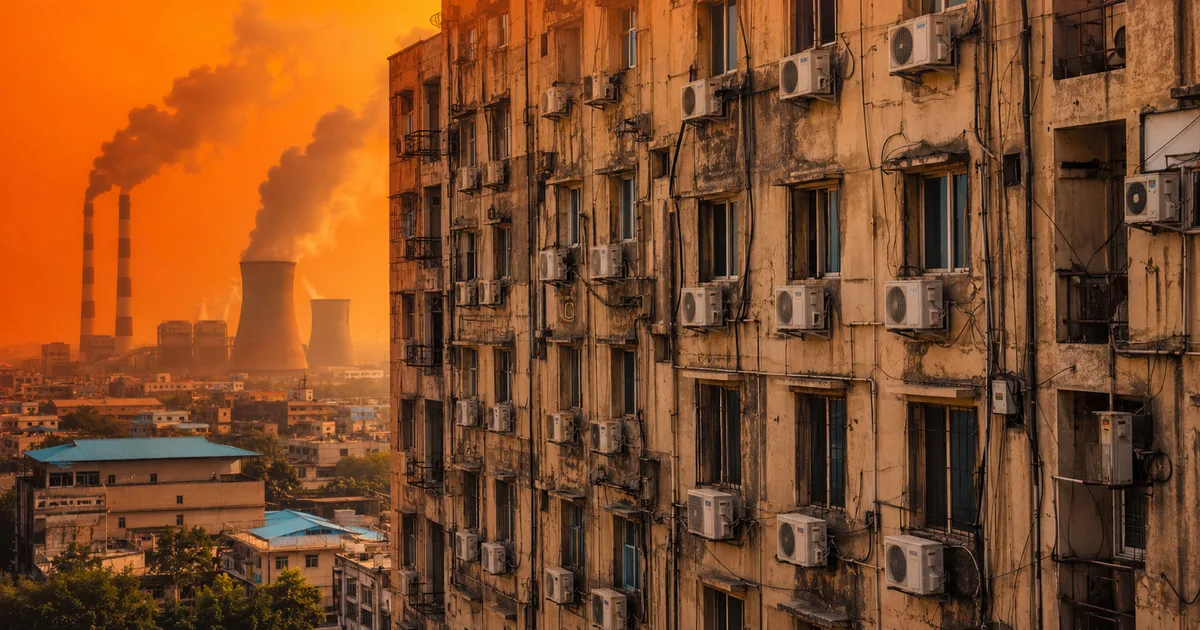
India Just Broke Its Power Demand Record. Your AC Played a Role.
On April 25, 2026, something unprecedented happened. India's electricity grid hit a record 256.1 GW of peak power demand — the highest ever recorded in the country's history. Temperatures had crossed 47°C in parts of Madhya Pradesh, Maharashtra, and Rajasthan. Every household, every office, every mall cranked up their air conditioners simultaneously.
The grid held. No nationwide blackout. But here's what most people didn't think about: to meet that demand, India burned more coal in a single week than some countries burn in a month. And every unit of electricity your AC consumed that day carried a hidden cost — one measured not in rupees, but in kilograms of CO₂ pumped into the atmosphere.
This isn't a guilt trip. It's a reality check. Let's understand the connection between your cooling comfort and the warming planet — and what you can actually do about it.
The Vicious Cycle: Heat → AC → More Heat
Here's the uncomfortable truth that climate scientists have been warning about for years: air conditioning creates a feedback loop.
- Rising temperatures force more people to buy and use ACs
- More AC usage spikes electricity demand
- Higher demand means more coal-fired power generation (since coal still produces nearly 69% of India's electricity)
- More coal burning releases more CO₂ and other greenhouse gases
- More greenhouse gases trap more heat, making future summers even hotter
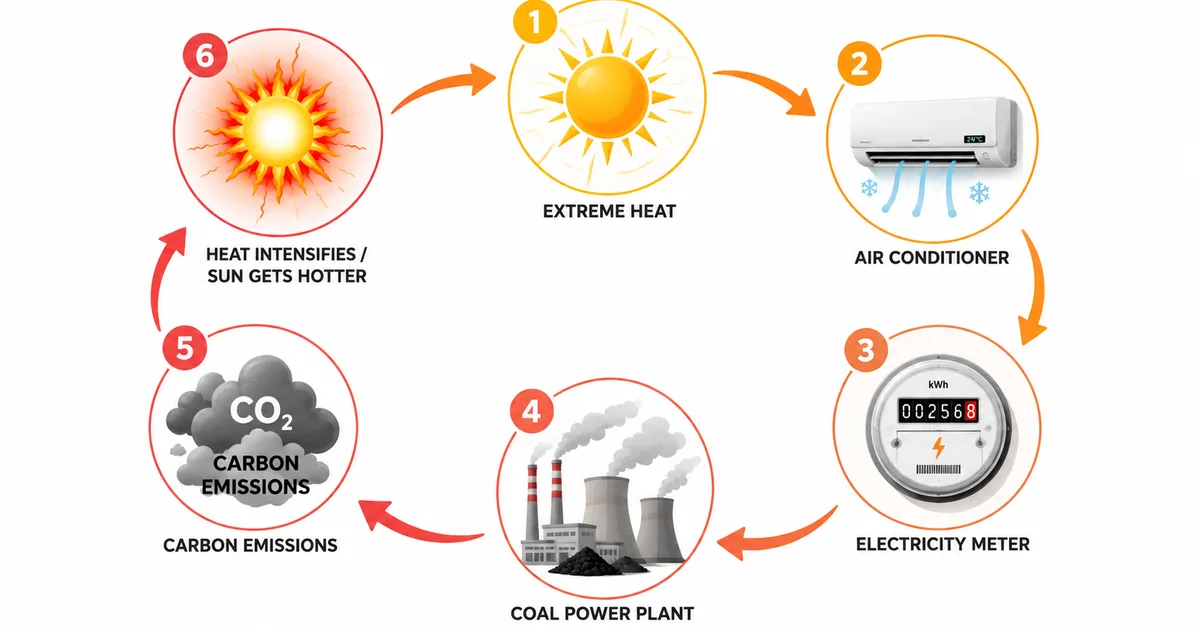
This isn't theoretical. India's AC emissions are now equal to emissions from all cars in the country, and they're projected to double by 2035. We're literally heating the planet to cool our rooms.
The Numbers: How Much Carbon Does Your AC Actually Produce?
Let's do the math. India's grid emission factor is approximately 0.72 kg CO₂ per kWh (as per CEA data referenced by IIT BHU). Here's what that means for your AC:
| AC Type | Daily Usage | Units/Day | CO₂/Day | CO₂/Summer (90 days) |
|---|---|---|---|---|
| 1.5 Ton, 3-star (non-inverter) | 8 hrs at 24°C | ~8 kWh | 5.8 kg | 518 kg |
| 1.5 Ton, 5-star (inverter) | 8 hrs at 24°C | ~5 kWh | 3.6 kg | 324 kg |
| 2 Ton, 3-star (non-inverter) | 8 hrs at 24°C | ~11 kWh | 7.9 kg | 713 kg |
To put 518 kg in perspective — that's equivalent to driving a petrol car from Delhi to Jaipur and back, three times. And that's just one AC in one household for one summer.
Now multiply that by the 130-150 million new ACs India is projected to add by 2035 (according to UC Berkeley's India Energy and Climate Centre). The scale of the problem becomes staggering.
Why India's Grid Makes This Problem Worse
If you're running an AC in France or Sweden, your carbon footprint from cooling is minimal — because their grids run primarily on nuclear and hydro power. But India's situation is different:
- 69% of electricity comes from coal — the dirtiest fossil fuel
- Peak demand hours (2-5 PM) coincide with maximum AC usage, and solar alone can't cover the evening peak
- Evening "double peak" — when the sun sets, solar drops off but ACs keep running, forcing coal plants to ramp up
- During the April 2026 heatwave, coal-fired generation rose to 164.9 GW — higher than the previous year
There's a silver lining though: during the same heatwave, solar energy met 30% of peak demand for the first time ever. The transition is happening — just not fast enough.
The AC Boom India Can't Ignore
Let's be clear: telling people not to use ACs when it's 47°C outside isn't realistic. Heat kills. In 2026 alone, the early-season heatwave has already strained public health systems. Cooling is a necessity, not a luxury.
The real question isn't whether to use ACs — it's how to cool smartly while minimizing the damage. Here's what the data tells us:
- India currently has roughly 80-100 million ACs installed
- By 2035, that number could cross 250 million
- Without intervention, ACs alone could demand 180 GW — 30% of India's projected peak load
- AC-related emissions could hit 329 million tonnes CO₂e by 2035
The Institute for Energy Economics and Financial Analysis (IEEFA) estimates extreme heat could cost India 2.5-4.5% of GDP by 2030. This is an economic crisis wrapped inside a climate crisis.
7 Ways to Cool Down Without Heating the Planet
Here's the good news: you don't have to choose between comfort and conscience. These strategies can cut your AC's carbon footprint by 40-70%:
1. Set Your AC to 24-26°C (Not 18°C)
The Bureau of Energy Efficiency (BEE) recommends 24°C as the sweet spot. Every degree you raise saves approximately 6% electricity. Running at 24°C instead of 18°C cuts your cooling emissions by over 30%. Pair it with a ceiling fan — you'll feel just as cool.
2. Upgrade to a 5-Star Inverter AC
A 5-star inverter AC uses 35-40% less electricity than a 3-star non-inverter model. Yes, it costs more upfront (₹8,000-15,000 extra), but it pays for itself within 2-3 summers through lower bills — and produces 200 kg less CO₂ per summer.
3. Seal Your Room Before Switching On
Up to 30% of cooling is lost through gaps in windows, doors, and poorly insulated walls. Simple fixes: use door sweeps, seal window gaps with weather strips, and use thick curtains on sun-facing windows. Your AC runs less, burns less coal.
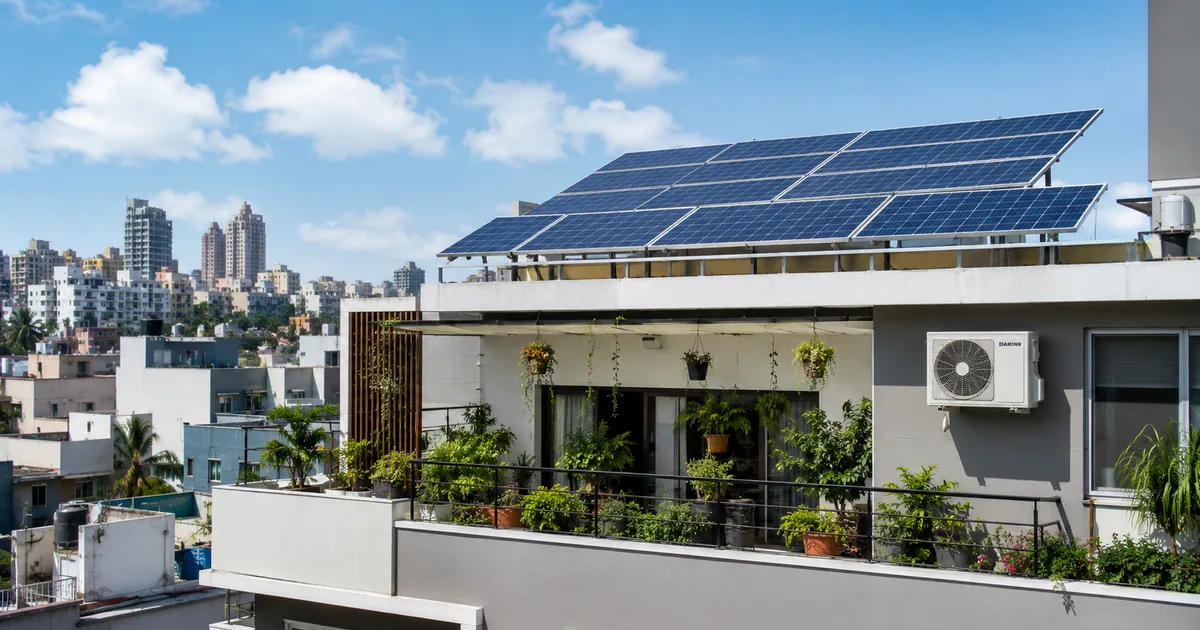
4. Install Rooftop Solar (Even 2-3 kW Helps)
A 3 kW rooftop solar system generates 12-15 kWh per day — enough to run your AC during peak sun hours with zero carbon emissions. With net metering, excess power goes back to the grid. The payback period is now 4-5 years, and panels last 25+ years.
5. Use Timer and Sleep Mode
Most people leave ACs running all night at full blast. Use the sleep mode — it gradually raises temperature as your body cools during sleep. A timer that shuts off at 2 AM (when outdoor temps drop) can save 3-4 hours of unnecessary running per night.
6. Service Your AC Every Year
A dirty filter makes your compressor work 15-20% harder. Annual servicing (cleaning filters, checking refrigerant levels, clearing condenser coils) maintains efficiency and prevents refrigerant leaks — which are themselves potent greenhouse gases (1,000-2,000x more warming than CO₂).
7. Offset What You Can't Reduce
After optimizing your usage, you can offset remaining emissions through verified carbon credit projects. With India's Carbon Credit Trading Scheme launching in 2026, there are now legitimate ways to fund emission reduction projects. Use our Carbon Footprint Calculator to measure your baseline first.
What India Is Doing at the Policy Level
The government isn't sitting idle. Several initiatives are addressing the AC-climate nexus:
- Stricter efficiency standards: BEE is raising minimum AC efficiency (ISEER) requirements, potentially saving 60 GW of peak demand and ₹7.5 trillion in grid investments by 2035
- Carbon Credit Trading Scheme (CCTS): Now covering 8 industrial sectors with mandatory emission targets — creating a price signal for carbon
- Renewable energy push: India added record solar capacity, with solar meeting 30% of peak demand during the April 2026 heatwave
- District cooling: GIFT City in Gujarat and Amaravati are piloting centralized cooling systems that are 40-50% more efficient than individual ACs
But policy alone won't solve this. Individual choices — multiplied across 1.4 billion people — matter enormously.
The Bottom Line
India's 2026 heatwave isn't an anomaly. It's the new normal. The last 11 years have been the hottest 11 years on record. Each summer will likely be worse than the last.
Your AC isn't the villain. But how you use it — and what powers it — determines whether you're part of the problem or part of the solution. A 5-star AC at 24°C, powered partly by rooftop solar, with proper insulation and annual maintenance, produces less than half the emissions of a poorly maintained 3-star unit blasting at 18°C in a leaky room.
Small changes, done by millions, add up to massive impact. Start by calculating your carbon footprint, then take one step at a time. The planet — and your electricity bill — will thank you.
Want to understand more about how carbon markets can help? Read our guide on What Is a Carbon Footprint or learn about how Indian farmers are earning from carbon credits.
Frequently Asked Questions
Related Articles

Carbon Credits for Beginners: India's Green Economy Explained
Learn what carbon credits are and how they drive India's green economy in 2026. Beginner-friendly...
Green Hydrogen India 2026: Projects, Cost & Carbon Impact
India's green hydrogen landscape in 2026: major projects, production costs, carbon reduction...
How to Plant a Tree in India: Carbon Offset Guide (2026)
Learn how to plant a tree correctly in India: best season, species selection, step-by-step guide,...