.png?alt=media&token=bfcc71bf-04da-4200-badf-6c9f66c06a3c)
EV vs Petrol Car India 2026: Cost, Emissions & Which Saves More
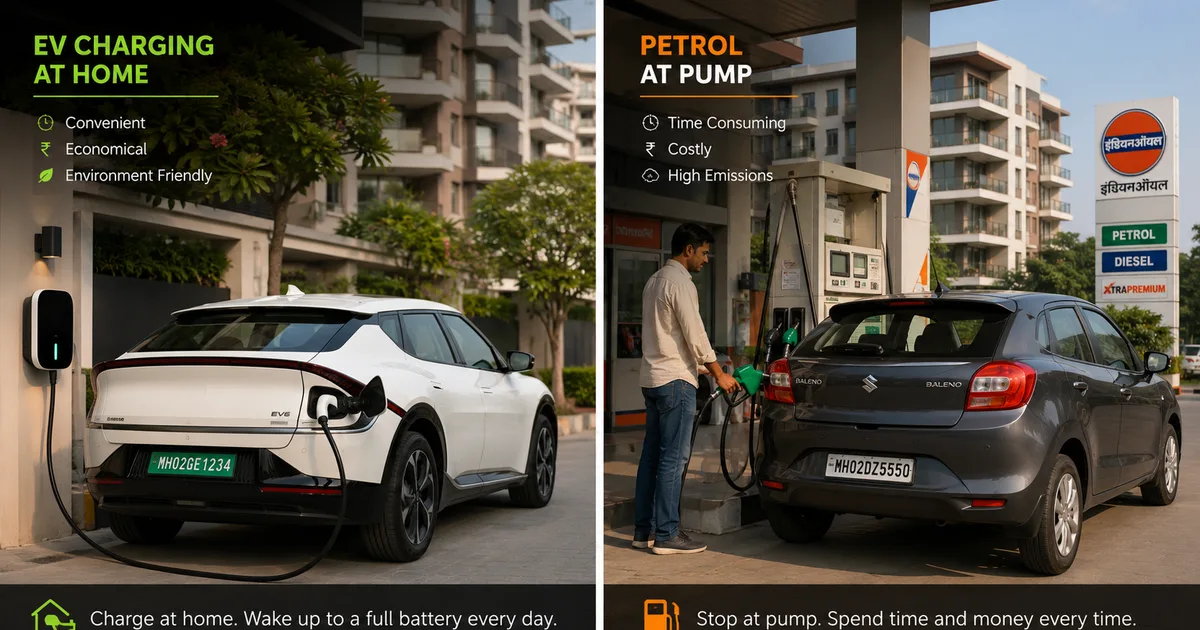
India Sold 24.5 Lakh EVs in FY26. Should You Be Next?
Something shifted in India's car market this year. Electric vehicle sales hit 24.52 lakh units in FY26 — a 24.6% jump over the previous year. Electric passenger cars alone surged 83.6%, with mid-size SUVs leading the charge. Petrol prices remain stubbornly near ₹100/litre across most cities, and rising oil import costs are squeezing the economy.
But the question most buyers still wrestle with isn't about trends or patriotism. It's practical: will an EV actually save me money? And how much less carbon will I produce?
This article answers both — with real 2026 numbers, not marketing fluff.
Running Cost: EV vs Petrol — The Per-Kilometre Math
Let's compare two popular cars in the same segment — the Tata Punch (petrol) vs Tata Punch EV (electric):
| Parameter | Petrol (Tata Punch) | EV (Tata Punch EV) |
|---|---|---|
| Fuel/Energy cost | ₹100/litre (petrol) | ₹7/kWh (home charging) |
| Efficiency | 18-20 km/litre | 7-8 km/kWh |
| Cost per km | ₹5.0-5.5/km | ₹0.9-1.0/km |
| Monthly cost (1,000 km) | ₹5,000-5,500 | ₹900-1,000 |
| Annual fuel/energy cost | ₹60,000-66,000 | ₹10,800-12,000 |
Bottom line: An EV costs roughly ₹1/km to run. A petrol car costs ₹5-5.5/km. That's an 80% reduction in running costs. Over 5 years at 12,000 km/year, you save approximately ₹2.5-3 lakh on fuel alone.
Even with public charging (₹15-20/kWh at fast chargers), EVs still cost only ₹2-2.5/km — half of petrol.
Total Cost of Ownership: 5-Year Comparison
Running cost isn't everything. Let's look at the complete picture over 5 years (60,000 km):
| Cost Component | Petrol Car | Electric Car |
|---|---|---|
| On-road price | ₹8-9 lakh | ₹12-14 lakh |
| Fuel/Energy (5 yrs) | ₹3.0-3.3 lakh | ₹0.5-0.6 lakh |
| Maintenance (5 yrs) | ₹1.0-1.5 lakh | ₹0.3-0.5 lakh |
| Insurance (5 yrs) | ₹1.5-2.0 lakh | ₹1.8-2.2 lakh |
| Road tax | ₹0.5-1.0 lakh | ₹0 (waived in most states) |
| Total 5-year cost | ₹14-16.8 lakh | ₹14.6-17.3 lakh |
| Resale value (approx) | 40-45% of purchase | 30-35% of purchase |
Note: Actual costs vary by city, variant, electricity tariff, insurance provider, loan terms, resale conditions, and charging mix. These figures represent averages for the compact SUV segment in metro cities.
The numbers are nearly equal over 5 years. If you drive more than 12,000 km/year (many urban commuters do 15,000+), the EV wins clearly. And this doesn't even factor in rising petrol prices — every ₹10/litre increase adds ₹30,000+ to the petrol car's 5-year cost.
As Times of India's 5-year breakdown analysis confirms, total cost of ownership now favors EVs by ₹1-1.5 lakh for high-mileage drivers.
Carbon Emissions: Where EVs Truly Shine
Now let's talk about the environmental impact — which is where things get interesting for India specifically.
Tailpipe Emissions
- Petrol car: ~120-150 g CO₂ per km (direct exhaust)
- EV: 0 g CO₂ per km (zero tailpipe emissions)
But What About Electricity Generation?
Critics correctly point out: India's grid still runs 69% on coal. So EVs aren't truly zero-emission when you account for power plant emissions. Let's calculate:
- India's grid emission factor: 0.72 kg CO₂/kWh
- EV efficiency: 7-8 km/kWh → approximately 90-103 g CO₂/km (grid emissions)
- Petrol car: 130-150 g CO₂/km (direct + upstream)
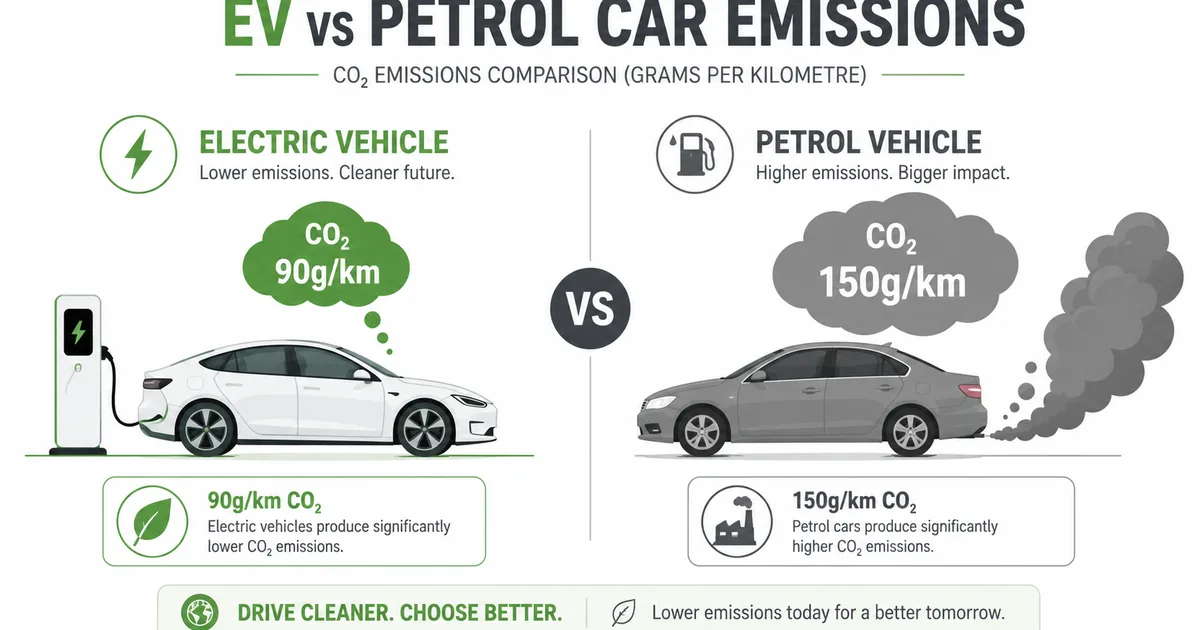
Even on India's coal-heavy grid, EVs produce 30-38% less CO₂ per kilometre than petrol cars. This finding is confirmed by Down To Earth's analysis of lifecycle emissions.
Lifecycle Emissions (Manufacturing + Driving + End-of-Life)
An IIT Madras study found that over a full vehicle lifecycle:
- Petrol car: ~53.84 tonnes CO₂ equivalent
- EV (India grid): ~33 tonnes CO₂ equivalent
- EV (renewable charging): ~15-18 tonnes CO₂ equivalent
That's a 39% reduction on the current grid, and up to 70% reduction if you charge with rooftop solar. As India's grid gets cleaner (target: 50% renewable by 2030), this gap will widen further in EVs' favor.
Annual Carbon Savings: What Switching Actually Means
If you drive 12,000 km/year and switch from petrol to EV:
| Metric | Petrol Car | EV (Grid) | EV (Solar) |
|---|---|---|---|
| Annual CO₂ emissions | 1,560-1,800 kg | 1,080-1,230 kg | ~200 kg |
| Annual savings vs petrol | — | 480-570 kg CO₂ | 1,360-1,600 kg CO₂ |
| Equivalent trees needed | — | 22-26 trees | 62-73 trees |
That's the equivalent of planting 22-73 trees every year, just by changing your car. Use our Carbon Footprint Calculator to see your personal numbers.
The 2026 EV Landscape: What's Changed
India's EV ecosystem has matured rapidly. Here's where things stand in 2026:
Sales Momentum
- 24.52 lakh EVs sold in FY26 — 24.6% growth YoY (FADA data)
- Electric passenger cars: 83.6% growth (mid-size SUVs dominating)
- Electric two-wheelers: 14+ lakh units (57.9% of all EV sales)
- Key players: Tata (market leader), Mahindra (rising fast), MG, Hyundai, VinFast (new entrant)
Charging Infrastructure
- Over 29,000 public EV charging stations installed across India (as per government data)
- Home charging covers 80%+ of daily needs for most urban drivers
- Highway corridors increasingly covered (Delhi-Mumbai, Delhi-Jaipur, Bangalore-Chennai)
Government Support
- Government support continues through PM E-DRIVE for electric two-wheelers, three-wheelers, buses, trucks, and charging infrastructure, while car buyers benefit more from state-level tax waivers and lower running costs
- Road tax waived in 20+ states for electric vehicles
- Income tax deduction on EV loan interest (Section 80EEB): up to ₹1.5 lakh
- NITI Aayog's e-AMRIT portal provides tools for comparing EV vs ICE costs
Who Should Switch to EV? (And Who Shouldn't — Yet)
EV Makes Sense If:
- ✅ You have home/office parking where you can install a charger
- ✅ Your daily commute is under 100-150 km (covers 95% of urban drivers)
- ✅ You drive 10,000+ km per year
- ✅ You're buying a second car or replacing an aging vehicle
- ✅ You have or plan to install rooftop solar
Petrol Might Still Work If:
- ⚠️ You frequently drive 300+ km in a single trip without planning stops
- ⚠️ You don't have dedicated parking for home charging
- ⚠️ Your budget is strictly under ₹8 lakh (though EV 2-wheelers solve this)
- ⚠️ You live in a rural area with no public charging within 50 km
The Carbon Credit Angle: Why This Matters Beyond Personal Savings
India's Carbon Credit Trading Scheme is moving from policy to implementation, and EV projects are emerging as a potential opportunity, especially for fleet operators. As the carbon market matures, the cost of carbon will increasingly be priced into fuel costs — making petrol even more expensive relative to electricity.
The logic is straightforward: every kilometre driven electrically instead of on petrol represents a verified emission reduction. While individual car buyers can't directly trade credits yet, fleet operators and companies are actively earning from EV-based carbon credit projects — and the ecosystem is growing rapidly.
Learn more: What Is a Carbon Footprint?
The Verdict
In 2026 India, the EV vs petrol debate is no longer about the future — it's about the present. The math is clear:
- Running cost: EV wins by 80% (₹1/km vs ₹5/km)
- 5-year TCO: Nearly equal; EV wins for high-mileage drivers
- Carbon emissions: EV produces 30-38% less CO₂ (current grid), 70% less with solar
- Maintenance: EV wins (no oil changes, fewer brake pad replacements, simpler mechanicals)
- Petrol wins on: Lower upfront cost, longer range anxiety-free highway trips, wider refueling convenience
For most urban Indian drivers doing 30-80 km daily with home parking, an EV is now the smarter financial and environmental choice. The savings compound every year, and as India's grid gets cleaner, the carbon advantage only grows.
Not sure about your own situation? Calculate your carbon footprint to see exactly how much you'd save by switching. Or explore how your other daily choices impact emissions.
Frequently Asked Questions
Related Articles

Carbon Credits for Beginners: India's Green Economy Explained
Learn what carbon credits are and how they drive India's green economy in 2026. Beginner-friendly...
Green Hydrogen India 2026: Projects, Cost & Carbon Impact
India's green hydrogen landscape in 2026: major projects, production costs, carbon reduction...
How to Plant a Tree in India: Carbon Offset Guide (2026)
Learn how to plant a tree correctly in India: best season, species selection, step-by-step guide,...