.png?alt=media&token=bfcc71bf-04da-4200-badf-6c9f66c06a3c)
New Solar Rule June 2026: Will Rooftop Solar Cost More?
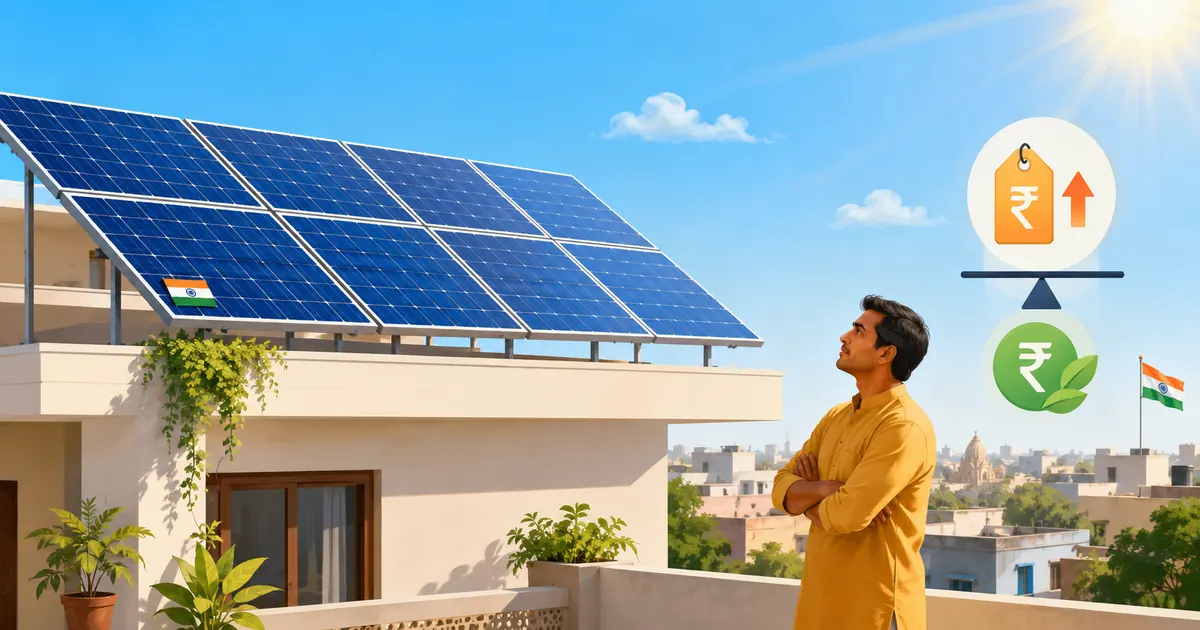
Quick answer: From June 1, 2026, rooftop solar systems under net-metering (including PM Surya Ghar) must use Indian-made solar cells (ALMM List-II), not just Indian panels. This raises installation cost by about ₹3,000 per kW — roughly ₹9,000 for a 3 kW system and ₹15,000 for a 5 kW system. The PM Surya Ghar subsidy continues unchanged, and for most homes solar remains well worth it.
What Just Changed in India's Solar Rules
Updated on June 5, 2026.
If you've been planning to put solar panels on your roof, there's important news. On June 1, 2026, a new rule from the Ministry of New and Renewable Energy (MNRE) came into effect — and it affects what your rooftop solar system will cost (PIB / MNRE).
Until now, India required rooftop solar projects (under net-metering and open-access, including PM Surya Ghar) to use domestically manufactured solar modules — the panels themselves. From June 1, the rule goes one step deeper: the solar cells inside those panels must also be Made-in-India, sourced from the government's approved ALMM List-II (MNRE ALMM).
The government has refused to extend this deadline (PIB / MNRE), so it's now in force. Here's exactly what it means for your wallet — and whether solar still makes sense.
First, How a Solar Panel Is Actually Made
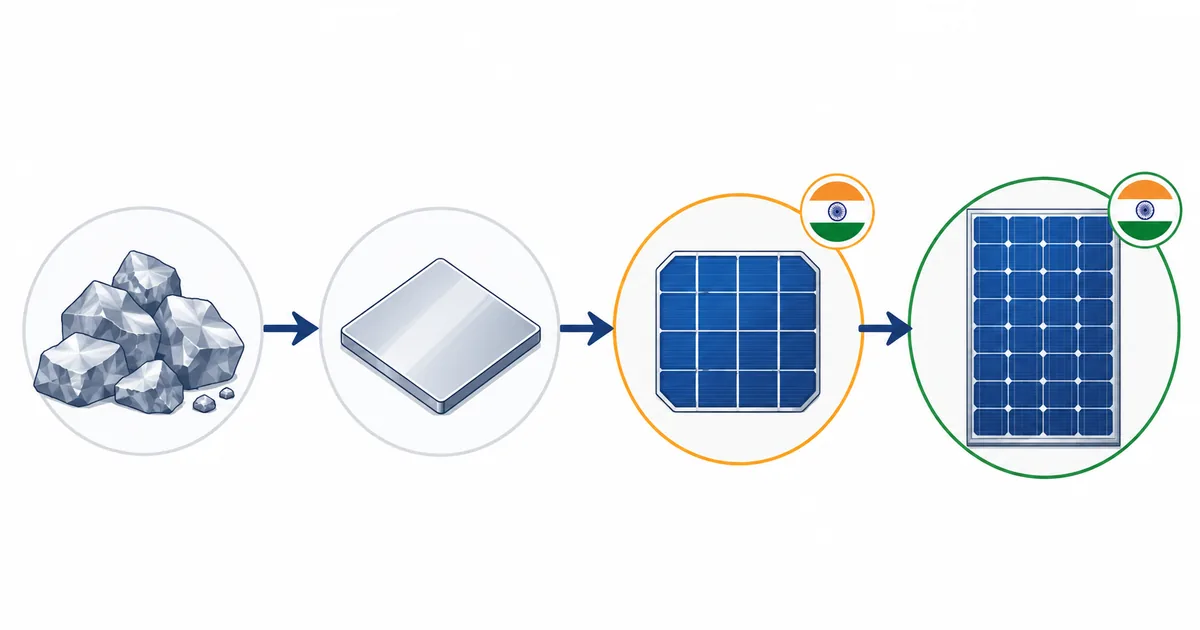
To understand the rule, you need to know the manufacturing chain:
- Polysilicon → refined raw material
- Ingots & wafers → silicon shaped into thin slices
- Solar cells → wafers turned into the part that actually converts sunlight to electricity
- Solar module (panel) → many cells assembled into the panel you see on roofs
India already mandated Indian-made modules (the panel, ALMM List-I). The June 1 rule now also mandates Indian-made cells (ALMM List-II) — the higher-value component that was often imported, mostly from China.
How Much More Will Rooftop Solar Cost?
Industry estimates put the increase at roughly ₹3,000 per kW (Financial Express; India TV). Here's what that means for typical home systems:
| System size | Approx. extra cost | Typical use |
|---|---|---|
| 1 kW | ~₹3,000 | Small home, basic load |
| 3 kW | ~₹9,000 | Average family home |
| 5 kW | ~₹15,000 | Larger home, heavy AC use |
₹3,000/kW is a common estimate, but some projections vary higher depending on cell supply, your installer, and how tight the domestic market is at the time. Prices may ease later in 2026 as domestic cell capacity ramps up. Either way, the increase is modest relative to the total system cost (a 3 kW system runs ₹1.8-2.4 lakh before subsidy).
Does This Affect the PM Surya Ghar Subsidy?
Good news: the PM Surya Ghar Muft Bijli Yojana subsidy continues uninterrupted. You still get up to ₹78,000 central subsidy for a 3 kW or larger residential system (plus state subsidies in places like Delhi, Haryana, and Rajasthan).
What changes is the paperwork. Because your system must now use ALMM List-II cells and List-I modules, your installer needs to document and prove compliant sourcing. Expect:
- Stricter documentation of cell and module sources
- Compliance checks during inspection
- Slightly longer verification in some cases
For the full subsidy process and eligibility, see our PM Surya Ghar 2026 guide.
Why the Government Made This Change
The rule is about reducing dependence on imported solar cells, particularly from China, and building India's own manufacturing base. The reasoning:
- Made-in-India: Keep more of the solar value chain (and jobs) within India
- Quality control: Government-approved manufacturers must meet defined standards
- Energy security: Less reliance on a single foreign supplier
India's solar cell manufacturing capacity has grown rapidly — up around 180% to about 33 GW, and projected to cross 60 GW by December 2026, which the government says is enough to meet domestic demand (BusinessWorld). MNRE has allowed only limited relief for projects already far along, otherwise the deadline holds.
The Honest Trade-off
There are two sides to this:
| The downside | The upside |
|---|---|
| ~₹3,000/kW higher upfront cost | Stronger Indian solar manufacturing & jobs |
| Stricter documentation | Better quality assurance on components |
| Possible short-term supply tightness | Reduced import dependence / energy security |
| Slightly longer payback | Subsidy intact; long-term savings unchanged |
Is Rooftop Solar Still Worth It? (The Numbers)
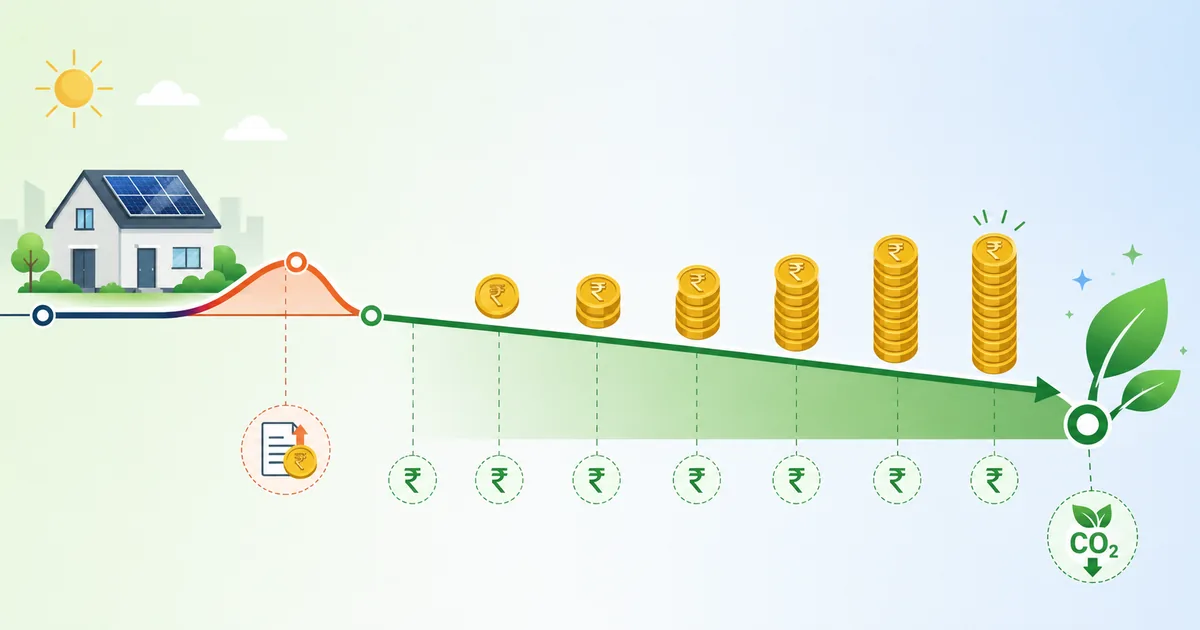
Short answer: for most households, yes — comfortably. The extra ₹3,000/kW is small against the lifetime returns. Let's run a realistic 3 kW example:
| Metric | 3 kW system (post June 1 rule) |
|---|---|
| Approx. cost before subsidy | ₹1.8-2.4 lakh + ~₹9,000 (new rule) |
| PM Surya Ghar subsidy | Up to ₹78,000 (unchanged) |
| Monthly generation | ~360-450 units |
| Monthly bill savings | ~₹2,000-3,500 |
| Payback period | ~4-6 years (slightly longer than before) |
| CO₂ avoided per year | ~4 tonnes |
| Panel lifespan | ~25 years |
The new rule pushes payback out by only a few months. After that, you still get ~20 years of near-free electricity and major carbon savings. With the grid emitting roughly 0.7 kg CO₂ per unit (latest available CEA grid factor), a 3 kW system remains one of the highest-impact climate actions a household can take.
Note: Costs, savings, and payback are approximate and vary by location, installer, cell supply, electricity tariff, and home size.
Should You Install Now or Wait?
- Install now if: Your bills are high, you have roof space, and you want to lock in the PM Surya Ghar subsidy. The ₹3,000/kW increase doesn't change the long-term math meaningfully.
- You might wait a few months if: You're flexible on timing and want to see whether domestic cell prices soften as capacity expands toward 60 GW by December 2026.
- Either way: Confirm your installer uses ALMM List-I modules and List-II cells, and keep the documentation — it's required for the subsidy now.
Calculate Your Solar Savings First
Before deciding, know your numbers:
- Use our Carbon Footprint Calculator to see how much CO₂ your electricity use creates — and how solar would cut it.
- Read the full PM Surya Ghar subsidy & application guide.
- Compare quotes from installers who can confirm ALMM List-I + List-II compliant components.
- Register on HaritKosh to track your energy savings and carbon reduction over time.
The Bottom Line
The June 1, 2026 solar rule makes rooftop systems slightly more expensive — about ₹3,000 per kW — by requiring Indian-made cells alongside Indian-made panels. But:
- The PM Surya Ghar subsidy is fully intact (up to ₹78,000)
- The cost rise is small versus 25 years of savings
- Payback extends by only a few months
- You still avoid ~4 tonnes CO₂/year with a 3 kW system
For most Indian homes, rooftop solar remains one of the smartest money-and-carbon decisions available. The new rule is a speed bump, not a roadblock. Check your numbers →
Sources
- PIB / MNRE — No blanket extension of ALMM List-II deadline beyond June 1, 2026 (official)
- MNRE — Approved List of Models and Manufacturers (ALMM), List-I & List-II (official)
- NDTV — India's June 1 domestic solar cell rule explained
- Business Today — ~₹15,000 extra for a 5 kW system
- Financial Express — Mandatory Indian cells, cost impact
- India TV — Cost impact by system size; subsidy continues
Disclaimer: Cost, savings, and payback estimates are approximate and depend on location, installer, component supply, tariff, and system size. Confirm current rules and ALMM compliance with your installer and the official PM Surya Ghar portal before deciding.
Keep reading: PM Surya Ghar Yojana 2026: Subsidy & How to Apply | How to Reduce Your Electricity Bill in Summer 2026 | World Environment Day 2026: 12 Climate Actions
Frequently Asked Questions
Related Articles

Carbon Credits for Beginners: India's Green Economy Explained
Learn what carbon credits are and how they drive India's green economy in 2026. Beginner-friendly...
Green Hydrogen India 2026: Projects, Cost & Carbon Impact
India's green hydrogen landscape in 2026: major projects, production costs, carbon reduction...
How to Plant a Tree in India: Carbon Offset Guide (2026)
Learn how to plant a tree correctly in India: best season, species selection, step-by-step guide,...