.png?alt=media&token=bfcc71bf-04da-4200-badf-6c9f66c06a3c)
World Environment Day 2026: 12 Climate Actions for India

World Environment Day 2026: Why This One Matters More
World Environment Day falls on Friday, June 5, 2026. This year the focus is Climate Change, under the theme "Inspired by Nature. For Climate. For Our Future." and the global campaign call #NowForClimate. The worldwide commemoration is hosted by the Republic of Azerbaijan in Baku and coordinated by the UN Environment Programme (UNEP).
For India, the timing is sharp. The IMD has revised its 2026 monsoon forecast down to around 90% of the Long Period Average — a below-normal season — with the Kerala onset arriving around June 4. Heatwaves pushed power demand to record highs in May. Water tables are falling. Climate change isn't a distant headline here; it's the weather outside your window.
So instead of another "plant a tree and save water" list, this guide gives you 12 real actions — each with the actual CO₂ impact so you know which ones matter most. Pick one. Start today.
First, Know Your Number
The average Indian emits roughly 1.9 tonnes of CO₂ per year — below the global average of ~4.7 tonnes. But that hides huge variation: a rural household may sit under 1 tonne, while an urban family with a car, AC, and a couple of flights can cross 8-15 tonnes.
You can't reduce what you don't measure. Before acting, use our free Carbon Footprint Calculator — it uses verified India-specific factors (CEA grid intensity, DEFRA flight data) and shows a category-wise breakdown so you target your biggest source first.
12 Climate Actions Ranked by Real CO₂ Impact
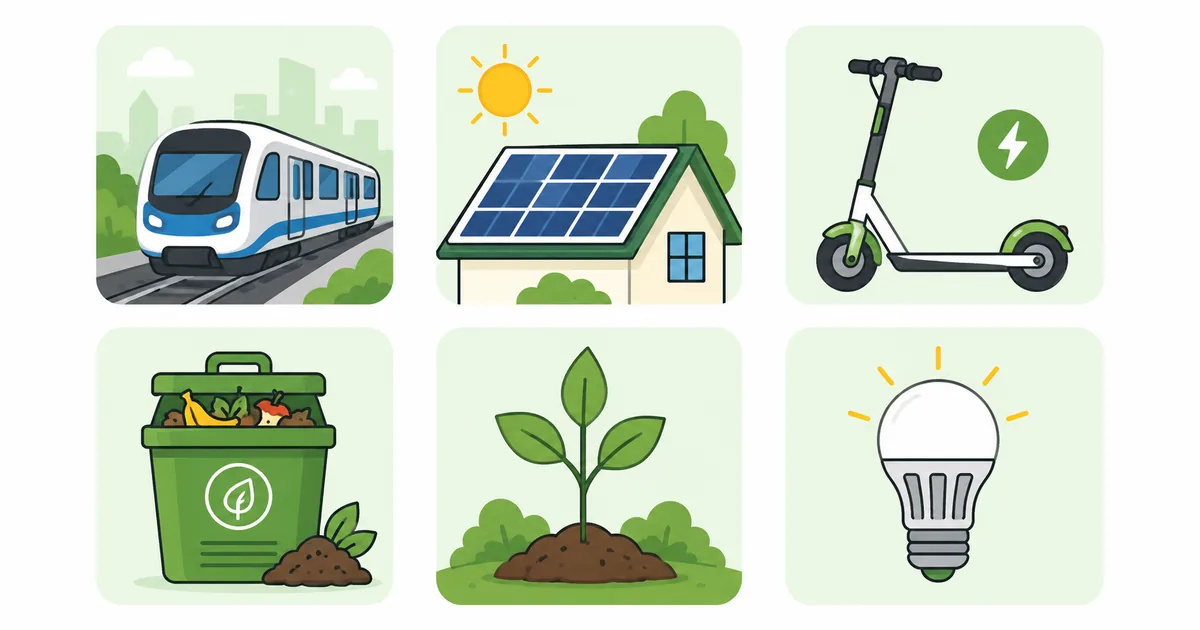
🚀 High Impact (hundreds of kg to tonnes per year)
1. Switch short car trips to metro, bus, or train
A petrol car emits ~0.187 kg CO₂ per km; a metro emits ~0.014 kg per passenger-km — over 90% lower. Replacing a 20 km daily car commute with metro can save roughly 1.2 tonnes CO₂/year.
2. Install rooftop solar
A 3 kW rooftop system avoids approximately 3.5-4 tonnes CO₂/year by displacing grid electricity. Under the PM Surya Ghar scheme you also get up to ₹78,000 central subsidy. Read our PM Surya Ghar guide.
3. Rethink one flight
A single domestic round-trip (e.g. Delhi-Mumbai) is ~250-300 kg CO₂; an international long-haul return can be 3-5 tonnes — more than an average Indian's entire yearly footprint. Combine trips or take the train for journeys under 1000 km.
4. Switch to an electric two-wheeler or car
On India's current grid, an EV emits ~50-65% less CO₂ per km than petrol — and near-zero if charged with rooftop solar. See our EV vs petrol comparison.
⚡ Medium Impact (50-300 kg per year)
5. Set your AC to 24-26°C
Every 1°C lower can raise AC energy use by ~6%. Running at 24-26°C instead of 18-20°C can cut 200-400 kg CO₂/year for a heavy-AC household, given the grid factor of ~0.716 kg CO₂/kWh.
6. Start home composting
Composting your kitchen waste avoids an estimated 150-200 kg CO₂e/year by preventing methane in landfills — and it's now expected under India's SWM Rules 2026. Our composting guide shows you how.
7. Plant and maintain trees
A mature tree absorbs ~22 kg CO₂ per year. Ten trees you actually keep alive offset ~220 kg/year once mature. Maintenance matters more than the number planted.
8. Switch all bulbs to LED
LEDs use 70-80% less energy than incandescent bulbs. A full-home switch can save 50-150 kg CO₂/year depending on usage.
💧 Everyday Habits (10-100 kg per year, but easy and additive)
9. Save water — it saves carbon too
In India, water is mostly pumped using electricity. Saving water cuts pumping emissions. See how in our water-carbon guide. Bucket baths over showers alone can save 20-40 kg CO₂/year on heated water.
10. Cut single-use plastic
Carry a cloth bag, refuse plastic cutlery, choose refillable bottles. Beyond CO₂, this directly reduces the plastic pollution that India's cities struggle to manage.
11. Run full loads only (washing machine + dishwasher)
A half-load uses nearly the same water and energy as a full one. Consolidating saves both — roughly 10-20 kg CO₂/year plus water.
12. Eat one more plant-based meal a week
Red meat is carbon-intensive. Shifting just a few meals a week toward dal, vegetables, and grains can trim 100-300 kg CO₂/year for regular meat eaters.
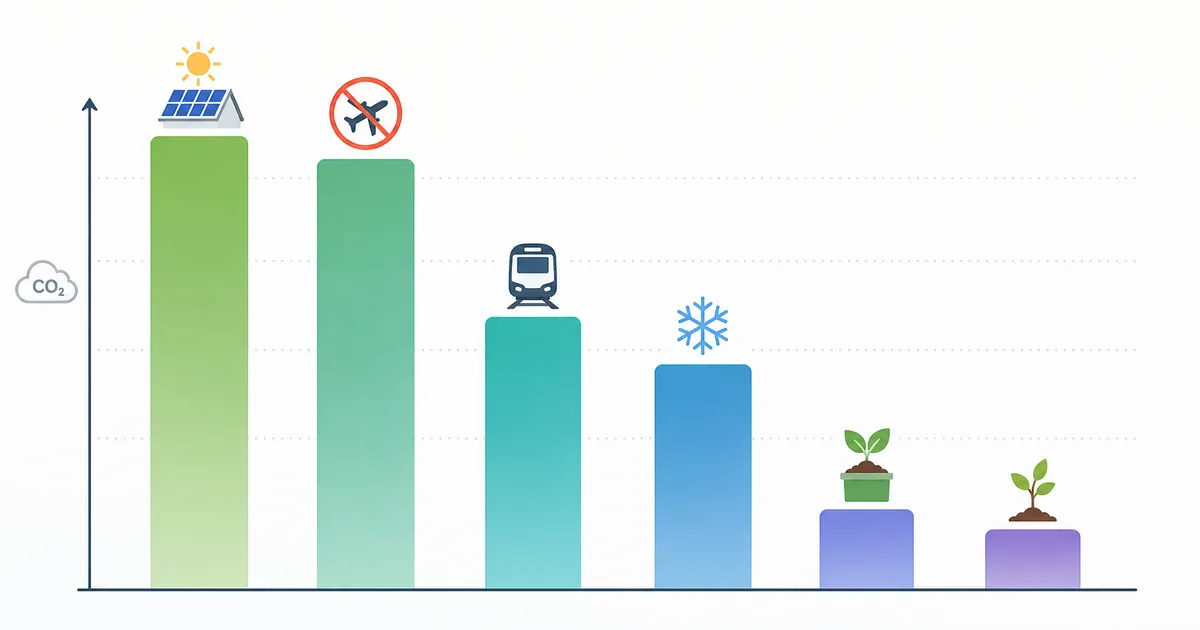
Quick Reference: Impact at a Glance
| Action | Approx. CO₂ saved/year | Effort |
|---|---|---|
| Car commute → metro/bus | ~1.2 tonnes | Medium |
| Rooftop solar (3 kW) | ~3.5-4 tonnes | One-time setup |
| Skip one long-haul flight | 3-5 tonnes per trip | Low |
| EV switch | ~0.5-1 tonne | One-time |
| AC at 24-26°C | 200-400 kg | Very low |
| Home composting | 150-200 kg | Low |
| 10 trees (mature) | ~220 kg | Ongoing |
| Full-home LEDs | 50-150 kg | One-time |
Note: All figures are approximate and vary by region, usage, electricity mix, and lifestyle. They use India-specific factors where available.
Make World Environment Day the Start, Not a One-Day Event
The point of #NowForClimate isn't a single day of tree-planting photos. It's building habits that compound. Here's a simple plan:
- Today: Calculate your carbon footprint and find your #1 emission source.
- This week: Pick one high-impact action from the list above that fits your life.
- This month: Register on HaritKosh to track your green actions and watch your savings add up.
- This year: Add one more action each month. By next World Environment Day, you'll have a measurable, real reduction.
What India Is Doing in 2026
World Environment Day 2026 is being marked across India with sustained campaigns rather than one-day events:
- Indian Railways ran a nationwide sustainability drive from May 15 to June 5, focusing on climate action, waste management, and cutting single-use plastic.
- State governments and municipal bodies are running tree-plantation and water-conservation drives.
- The broader policy backdrop — the live Indian Carbon Market, PM Surya Ghar rooftop solar, and SWM Rules 2026 — means individual actions increasingly connect to national systems.
The Bottom Line
World Environment Day 2026 lands in a year India can feel the climate shifting — a below-normal monsoon, record heat, stressed water. The theme is Climate Change for a reason. But the response doesn't have to be overwhelming:
- Measure first — know your biggest source
- Pick one high-impact action this week
- Track it, then add another
One household acting consistently saves hundreds of kilograms of CO₂ a year. Scale that across a billion people, and June 5 stops being a hashtag and starts being a turning point. Start with your number →
Sources
- World Environment Day 2026 — Official theme & host (UNEP)
- UNEP — Azerbaijan to host World Environment Day 2026
- Business Today — IMD revises 2026 monsoon to ~90% of LPA
- ETV Bharat — Indian Railways World Environment Day campaign 2026
- CEA — CO₂ Baseline Database v20 (grid emission factor)
Disclaimer: CO₂ savings estimates are approximate and depend on individual usage, region, electricity mix, and lifestyle. Figures are intended as general guidance to help prioritise action.
Keep reading: Home Composting in India 2026 | PM Surya Ghar Rooftop Solar Subsidy | Save Water, Cut Carbon | EV vs Petrol India 2026
Frequently Asked Questions
Related Articles

Carbon Credits for Beginners: India's Green Economy Explained
Learn what carbon credits are and how they drive India's green economy in 2026. Beginner-friendly...
Green Hydrogen India 2026: Projects, Cost & Carbon Impact
India's green hydrogen landscape in 2026: major projects, production costs, carbon reduction...
How to Plant a Tree in India: Carbon Offset Guide (2026)
Learn how to plant a tree correctly in India: best season, species selection, step-by-step guide,...